
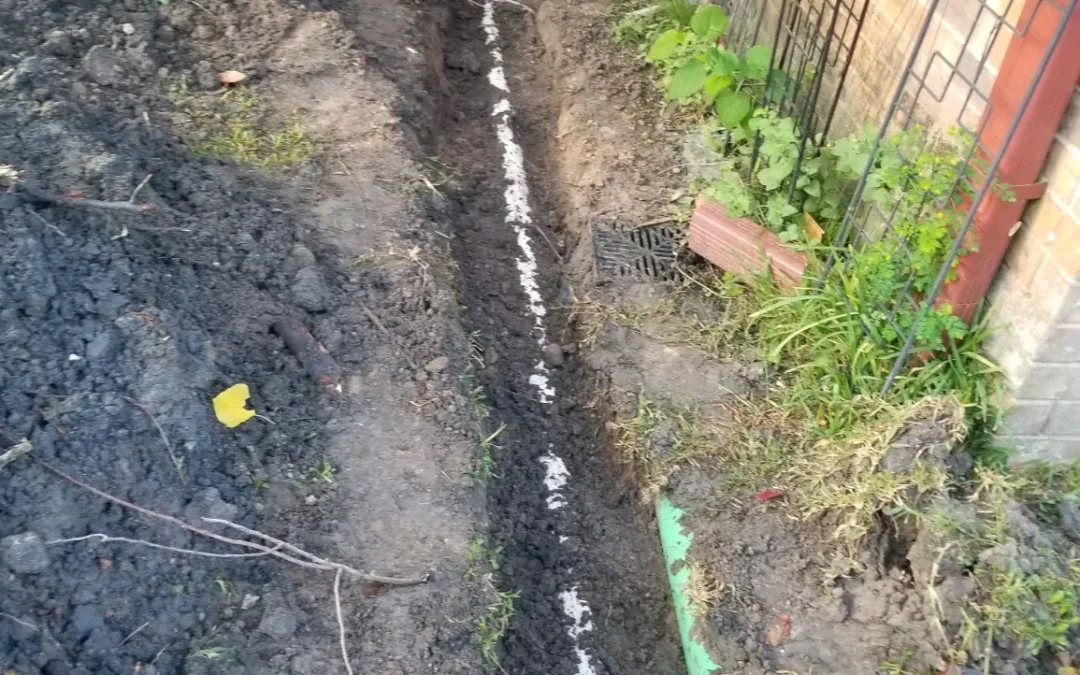
If your yard still has puddles the day after a rain, that is not just “Houston being Houston.” Standing water means the water has nowhere useful to go. In Greater Houston, the usual reasons are clay soil, a low spot with no outlet, and downspouts that dump roof water right beside the house.
Drain X Perts is a yard-drainage company based in Alvin. We do outdoor drainage only — yards, landscape, and foundation drainage — and we will tell you honestly which system belongs on your property.
Call (832) 776-8003 for a free on-site estimate.
Why Houston yards hold water
Greater Houston yards are full of clay. Clay takes in water slowly. Our storms often drop a lot of rain in a short time, so the ground cannot absorb it fast enough. Water sits on the surface, finds the lowest point, and stays there.
A wet yard during a storm is common here. A yard that is still holding water more than a day later, or that stays soggy between rains, needs a real drainage plan — not a wait for the next dry spell.
The usual causes of standing water
Clay soil that cannot keep up with a Gulf Coast storm
A French drain is a gravel trench with a perforated pipe. It only works if water can soak into the soil and find that pipe. In clay, that happens too slowly, and the trench cannot keep up. If a “French drain” is already in the ground and the puddles came back, that is often why.
Most slab-foundation yards here need an area drain instead: catch basins at the low spots and solid pipe that carries water off the property. We explain the difference on our French drains vs area drains page, and in more depth at frenchdrainsinhouston.com.
A low spot, or a yard that does not slope to an outlet
Water follows gravity. If the back of the lot is lower than the front, or a bed, patio, or play area sits in a bowl, water will collect there. Even a well-built drain fails if the pipe is flat, runs uphill, or ends in a flower bed with nowhere to go.
Downspouts that empty at the foundation
Roof water has to go somewhere. If downspouts spill beside the slab, that water adds to whatever is already sitting in the yard and can pool against the house. Tying the downspouts into an underground line that runs to the street or a safe outlet is often part of the fix. That work is covered on our downspout drainage page.
The wrong drain, or a drain with no real outlet
A lot of our calls come from homeowners who already paid for a drain that does not work: cheap corrugated pipe in a gravel trench, a pipe that ends in a pop-up emitter in a flat yard, a line that is too small for a property that floods, or a system sold as a French drain when the yard needed catch basins and solid pipe. Doing the job right the first time is always less expensive than tearing it out later.
How to tell if you need a drainage system
Watch the yard after the next rain. These are the signs we look for:
- Standing water that lasts more than a day after rain
- Soggy, spongy spots in the lawn, or patches of dead grass
- Water pooling against the slab or running under the garage door
- Mulch and soil washing onto patios and sidewalks
- Erosion along fence lines or the side yard
- Downspouts that dump roof water right beside the foundation
If you see those, a catch basin in the low spot and solid pipe to a real outlet will usually move the water out. A French drain still has a place under a crawl space or pier-and-beam home, and under flower beds. For a typical yard, it is usually the wrong tool.
What actually fixes standing water in a Houston yard
The fix starts with how water already moves across your lot — not with a product name you typed into a search bar.
- We walk the property first and look at slope, low spots, the foundation, and the downspouts.
- We recommend the right system. For most yards, that is an area drain system: catch basins, solid pipe, and an outlet to the city’s drainage. In the limited cases above, a French drain may be part of the plan.
- We use the right pipe. Most homes are well served by 4-inch pipe. For properties that flood, we recommend a 6-inch line, which keeps up with the downpours that overwhelm a 4-inch system.
- We keep the slope correct from start to finish and give the water a real outlet.
- We restore the yard: trenches are backfilled, grass is put back, and the site is cleaned up before we leave.
- We stand behind the work with a 2-year workmanship warranty. Where a city permit is required, we pull it.
Most residential jobs take 2 to 3 days, depending on the size of the job. After the first heavy rain, most customers tell us the same thing: the water that used to sit for days is gone.
Winter and early spring, when yards are drier and easier to work, is a good time to get this done — before the heavier spring storms.
Standing water FAQ
How long should water sit in my yard after it rains?
A little water during a storm is normal. Water that is still standing more than a day after the rain, or a lawn that stays spongy between storms, is a drainage problem.
Will a French drain fix standing water in my Houston yard?
Usually no. French drains do not work well in Houston clay. They make sense for crawl spaces and pier-and-beam foundations, and under flower beds. Most yards need area drains — catch basins and solid pipe — to pick water up off the surface and carry it away. Read the full explanation on our French drains vs area drains page.
Can I fix standing water myself with dirt or a store-bought kit?
Filling a low spot can help a little, but it often just moves the puddle. A kit with no real outlet, or with pipe that sits flat, will clog or overflow in the first hard rain. The reliable fix is a system designed for your lot, with the right pipe, slope, and a place for the water to go.
How long does installation take?
Typical residential jobs take 2 to 3 days, depending on the job.
Do you do indoor plumbing or septic work?
No. Drain X Perts does outdoor drainage only: yard, landscape, and foundation drainage.
Get a free drainage estimate
If standing water is in your yard after it rains, we will walk the property with you and tell you what it actually needs. Drain X Perts has more than 25 years in this work and has installed more than 2,000 drainage systems across Greater Houston, including Alvin, Katy, The Woodlands, and The Heights.
Call (832) 776-8003 or request a free on-site estimate.